
Hofstede's Dimensions: A Compass for Understanding Cultures
Discover Hofstede's 6 cultural dimensions and how to apply them to improve collaboration in multicultural teams.
In previous articles, we discussed ethnocentrism and culture shock, as well as how high-context and low-context cultures influence communication. In this new post in the series, we explore a fundamental framework for understanding cultural differences in a structured way: Geert Hofstede’s cultural dimensions.
What Are Hofstede’s Dimensions?
Geert Hofstede, a Dutch researcher, proposed a model to understand how cultural values influence people’s behavior in different societies. These dimensions are especially useful when working with global teams, as they allow us to anticipate potential friction and adapt our communication, leadership, and collaboration.
The 6 cultural dimensions:
Power Distance : How hierarchical is a society? In cultures with high power distance (such as Mexico or India), decisions are expected to come from the top. In contrast, in cultures with low power distance (such as Denmark or New Zealand), horizontal structures and access to leadership are valued.
Individualism vs. Collectivism : In individualistic cultures (such as the U.S. or the Netherlands), people prioritize their personal goals. In collectivist cultures (such as Japan or Colombia), the well-being of the group is more important.
Assertiveness This dimension reflects the extent to which a culture values competition, achievement, and assertiveness, as opposed to values such as cooperation, modesty, and caring for others.
Uncertainty Avoidance : How is ambiguity handled? Cultures such as Germany or Greece tend to avoid uncertainty through strict rules. In contrast, cultures such as Singapore or India are more tolerant of ambiguity.
Long-Term vs. Short-Term Orientation: Long-term-oriented cultures (such as China or South Korea) value perseverance and planning. Short-term-oriented cultures (such as the U.S. or Argentina) tend to focus on immediate results.
Indulgence vs. Restraint : What role does enjoyment play in daily life? In indulgent cultures (such as Mexico or Australia), enjoying life is valued. In restrictive cultures (such as Russia or South Korea), impulse control is emphasized.
What is this model used for?
Hofstede’s model is neither a precise formula nor a label, but rather a guide for understanding general cultural trends. It helps to:
Understand how different cultures respond to leadership, authority, and decision-making.
Adapt strategies for communication, negotiation, or motivation.
Prevent misunderstandings that arise from assuming that “everyone thinks like me.”
Practical example:
A useful tool for visualizing these differences is Hofstede’s country comparison tool, which allows you to compare cultural dimensions across different countries.
For example, when comparing Japan and Uruguay, significant differences can be observed:
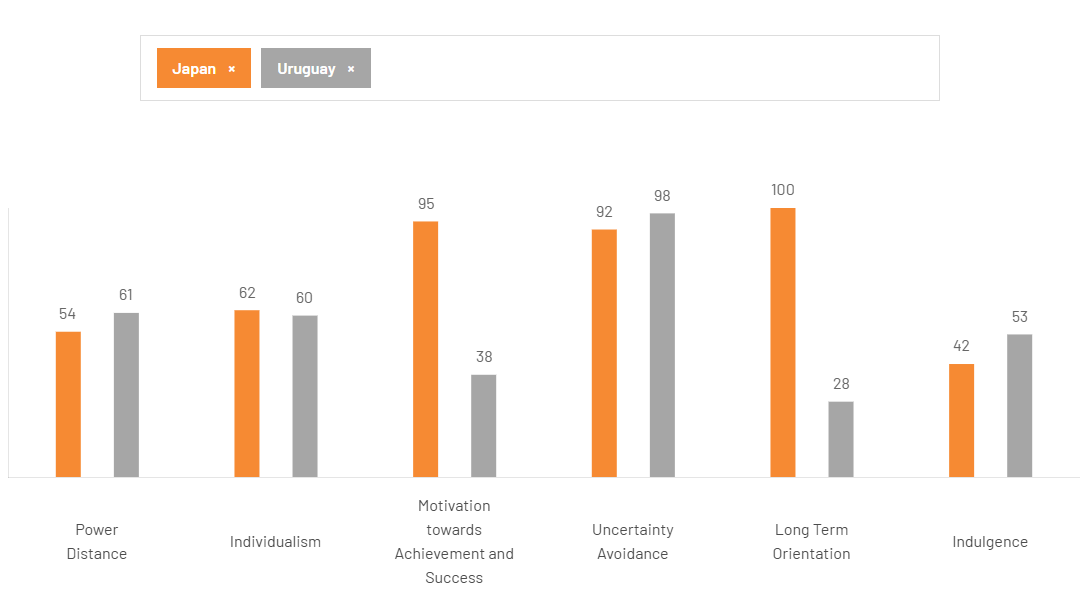 Hofstede’s Dimensions
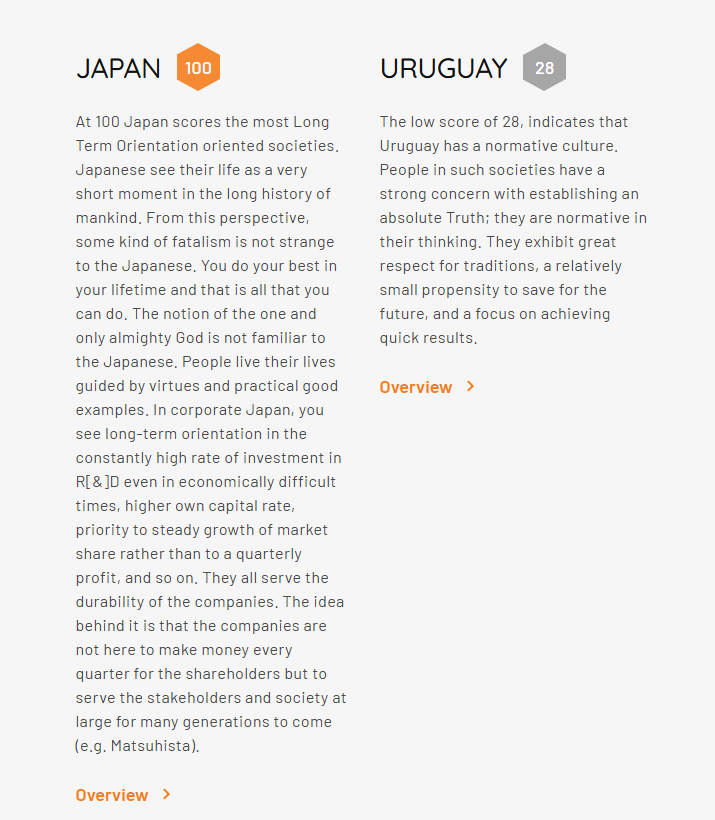
What’s interesting about this tool is that you can click on each dimension to learn more about the differences. For example, clicking on “Long-Term Orientation” reveals the following:
These cultural differences can influence work dynamics, decision-making, and communication within multicultural teams. Understanding them is key to fostering effective collaboration and mutual respect.
If you’re about to start a new project, present a proposal to a multicultural team, or plan a meeting, comparing the cultures involved using this tool can be an excellent starting point. It allows you to identify key differences and anticipate potential misunderstandings, so you can then design strategies that facilitate collaboration and mutual understanding.
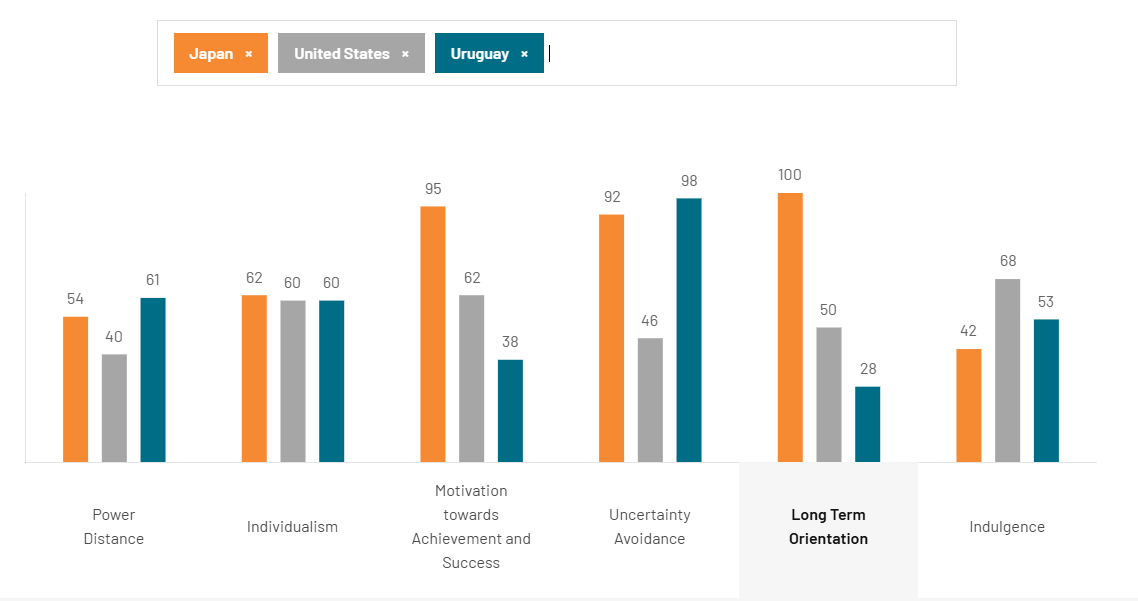
Final Thoughts
Hofstede’s cultural dimensions are a valuable tool for beginning to understand how cultures differ from one another, but they are not the only model available. There are other equally relevant approaches, such as the GLOBE model, Schwartz’s model, Hall’s model of intercultural communication, and Erin Meyer’s model in *The Culture Map*, among others. The model by Trompenaars and Hampden-Turner also offers a complementary perspective. If this topic interests you, I encourage you to explore different theoretical frameworks and combine them with your own experience: it is at this intersection that a deeper and richer understanding of cultural diversity emerges.
Familiarity with these models doesn’t mean falling into stereotypes; rather, it means opening your mind to other ways of seeing the world. In my experience, when a team begins to discuss these differences with an open mind, it becomes more empathetic, more powerful, and, above all, more human.
See you next time!
P.S.: If you’re interested in cultural awareness and how to empower multicultural teams, I invite you to follow me on Substack. Subscribe here to instantly receive every new post in this series. 🚀🌍