
The Passenger's Philosophy
Review of Michael Marder's book *The Philosophy of the Passenger*.
Hi! Today I'd like to share a brief review of a really interesting book I read just recently: *The Philosophy of the Passenger* by Michael Marder.
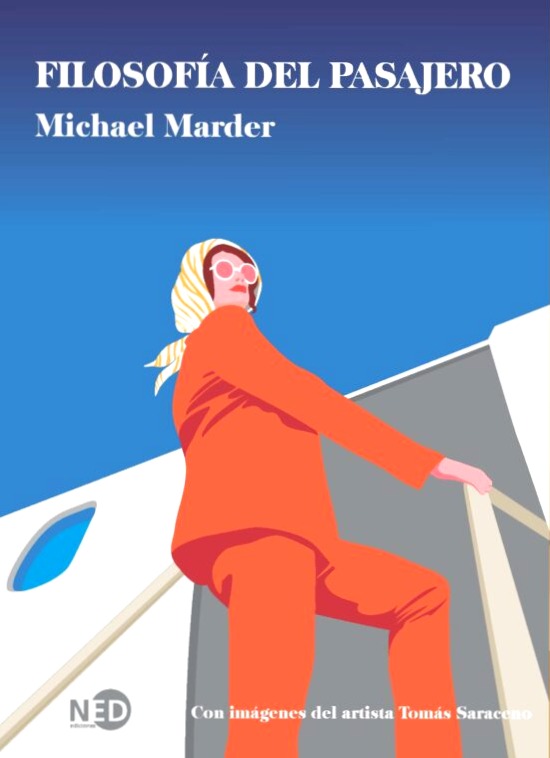 The Philosophy of the Passenger
Michael Marder is a philosopher who, in this book, dissects the universal experience of being a passenger. The book is a philosophical guide to the condition of being a passenger, whether on long-distance trips or in everyday commutes. Drawing on the experience of travel itself, it weaves together the most essential themes of existence, such as time, space, the self, solitude, and the senses. From the moment a ticket is purchased until arrival at the destination, the author uses every moment to sketch the characteristics of a universal traveler and the human essence.
Although it is a philosophical read, with numerous references and layers of information, it is a very enjoyable book that draws you in from the very beginning. It contains many curious and interesting facts about travel, airplanes, and airports, to which it adds various layers of complexity, references, and philosophical concepts.
The book was published in October 2022, so it’s very current, and it delves deeply into all the situations arising from the pandemic, as well as the practical impossibility we faced for several months of traveling and how that impacted our perspective on life itself.
I’d like to share a few excerpts that I think illustrate the book’s tone and rhythm very well.
“A teenager listening to music at full volume in a subway car, with the drums and bass spilling out of his headphones; a businesswoman working on her laptop during a transatlantic flight; a man speaking agitatedly on his cell phone during an intercity bus ride; a person reading a book on a train... All of them are separate bubbles, worlds that barely intersect, except as bodies occupying a limited (often uncomfortable) space for a fraction of a moment.”
"Passivity. To be a passenger is to be transported by something and by someone else, just as you yourself are the means of transport for an imperceptible excess (both real and symbolic). It is to cede the active role of driving, guiding, steering, piloting, helmsmanship, or direction to another (person or machine, as in the case of automated navigation systems)."
"Class hierarchy. The randomness of passengers’ gatherings masks a rigidly stratified order of which they are a part. Executive class, economy, business, first, second, premium, standard: these are just some of the class designations for passengers who must reproduce, during their travels, the dynamics of the socioeconomic classes to which each group of passengers belongs—brought together by a mix of chance and class, they form a transient society of passersby. If there were a single class with capacity for everyone, we would have a classless passenger experience in which we would all travel with the same level of comfort, legroom, service, and number of restrooms per person. That, in miniature, is a variation on the Marxist theme of a classless society—a society in which the distinction between the first and the second class, as well as between the first and the last, has been abolished. A society without society, perhaps?”
"Didn’t the pandemic reveal a similar difficulty in movement—from border closures, through flight and train cancellations, to strict lockdowns? The world itself lost the veneer of transparency and permeability with which it had been endowed in the eyes of a privileged few during the era of globalization. The difficulty of passage, then, has to do not only with the closure of borders, but also with fear and an awareness of the dangers inherent in being a passenger. For a short time, we could not be passengers, and that was enough to shake our passenger-like attitude toward reality to its core.”
"In fact, passports are an invention of Johann Gottlieb Fichte, a German philosopher whose life spanned the second half of the eighteenth century and the early years of the nineteenth. In his *Foundations of Natural Law*, Fichte recommends the use of police-style passport prototypes, in which “the principal maxim” is that “every citizen must be easily identifiable, when necessary, as this or that particular person. Every person must always carry an identity card [pass], issued by the nearest authority and containing an accurate description of the person; this applies to everyone, regardless of class or rank. Since purely verbal descriptions are always ambiguous, it would be advisable for important persons (who, therefore, can also afford to do so) to carry accurate portraits on their identity documents, rather than descriptions.”
"Therefore, the condition of being a passenger is not merely a metaphor, nor is it the purely literal condition of being a passenger. It is to pass through that which, in itself, traverses, passes, and moves away. Modern modes of transportation that mass-produce the passenger’s experience—or lack thereof—drop us by parachute into the beating heart of modernity, which, more than a life in the fast lane, is the accelerated movement of the pace that leaves us no time to recognize what or who has passed by, or whom or what we have passed by. Passenger transport is a metaphor in the most literal sense of “transferring.” Metaphors are the most literal vehicles for passages of meaning.”
"When does a journey end? When do you get off a ship, a plane, a bus, or a train? When does reading stop? When do you close a book and put it on a shelf? Is there such a clear cutoff point? Doesn’t the process continue to move forward, unfolding as if by inertia, even after the passenger’s experience of traveling or reading has ended, having reached its final destination or last stop?”
I think these quotes reflect the book’s dynamic. I definitely recommend it to anyone who loves travel and philosophy, as I’m sure you’ll enjoy every page. Until next time, and happy reading!