
Culture and Multiculturalism: An Introduction to Cultural Awareness
Multicultural teams drive innovation, but they also present challenges. This article explores key concepts for successfully leading them
Hello!
Imagine a development team led by an AI engineer from Bangalore, with a UX designer from São Paulo, a front-end developer from Berlin, a project manager from Tokyo, a product manager from Mexico, and a sales representative from Canada. Does this sound familiar? This is becoming increasingly common, especially for those of us who work in technology. Each team member brings a unique cultural and professional perspective, creating a global team brimming with innovation and creativity. However, managing this diversity presents significant challenges. How can we turn these differences into strengths and overcome cultural barriers?
In a world increasingly driven by AI, human relationships remain essential for authentic and enriching collaboration. The ability to connect, understand, and value our cultural differences is more crucial than ever for developing technological solutions that truly transform people’s lives.
This is a topic I’m passionate about and one I’ve reflected on throughout more than 12 years of working with clients and professionals around the world. I’ve also supplemented this experience with specialized courses and readings on multicultural teams. Throughout 2025, I plan to share some ideas and tools for addressing these challenges.
In this first post, we’ll explore two key concepts that will serve as the foundation for future reflections: culture and multiculturalism.
Defining Culture
For the first concept, culture, I like to refer to a classic definition formulated in 1980 by Geert Hofstede. Hofstede, a Dutch anthropologist and pioneer in intercultural studies, defined culture as:
“The programming of the human mind by which one group of people distinguishes itself from another group.”
I find this definition particularly useful because it does not seek to list all the elements that make up culture, but rather focuses on the collective. From this definition, I emphasize that culture is something we learn from our environment and is always a shared construct.
When we talk about culture, there are two widely used models that add dimensions and depth to this definition: the cultural iceberg and the layers of culture.
The Culture Iceberg
This model, presented by anthropologist Edward T. Hall (don’t forget about Hall—we’ll return to him in future posts), serves as a framework for understanding the layers of cultural elements that define a society. The visible part includes explicit elements such as language, customs, and rituals, which represent the “easily” observable aspects of culture.
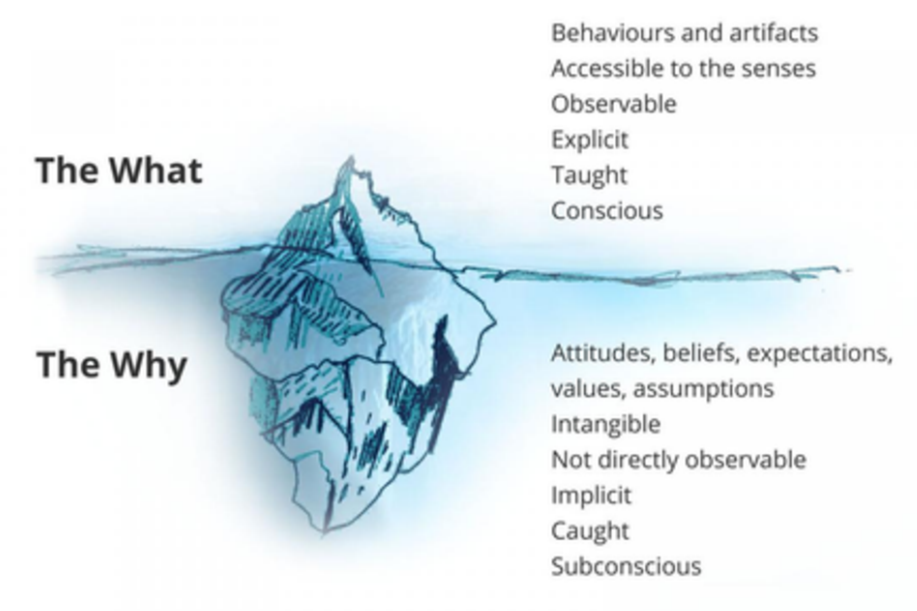 The Culture Iceberg
In the submerged layers are other elements such as implicit beliefs, values, norms, and tacit communication patterns that operate beneath the surface.
The Layers of Culture
This model helps us understand that an individual’s culture is not static but consists of several interrelated layers. Therefore, it is important to note that when we talk about culture, we focus on the common elements that a group of people may share. However, we must also consider that each individual is influenced by a range of dimensions and variables that shape their behavior and their own cultural perception.
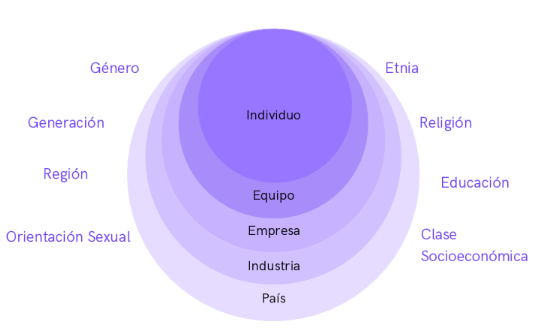 The Layers of Culture
Defining Multiculturalism
Let’s now move on to the second concept: multiculturalism. This refers to the coexistence of different cultures within the same setting, while respecting the unique characteristics of each.
Cultural awareness, on the other hand, is the ability to recognize, understand, respect, and appreciate cultural differences.
This skill is increasingly necessary for leading teams in a world where globalization, remote work, and greater workplace flexibility have facilitated mobility among people and interaction between cultures, resulting in greater cultural diversity in the workplace.
Final Thoughts
In the following posts, I’ll delve deeper into different concepts, frameworks, and tools that will help us develop this cultural awareness.
See you next time!
P.S.: If you’re interested in cultural awareness and how to empower multicultural teams, I invite you to follow me on Substack. Subscribe here and instantly receive every new post in this series.🚀🌍